What Are Web3 Gaming Guilds? Scholarships, DAOs, and Revenue Sharing Explained
 16 min read
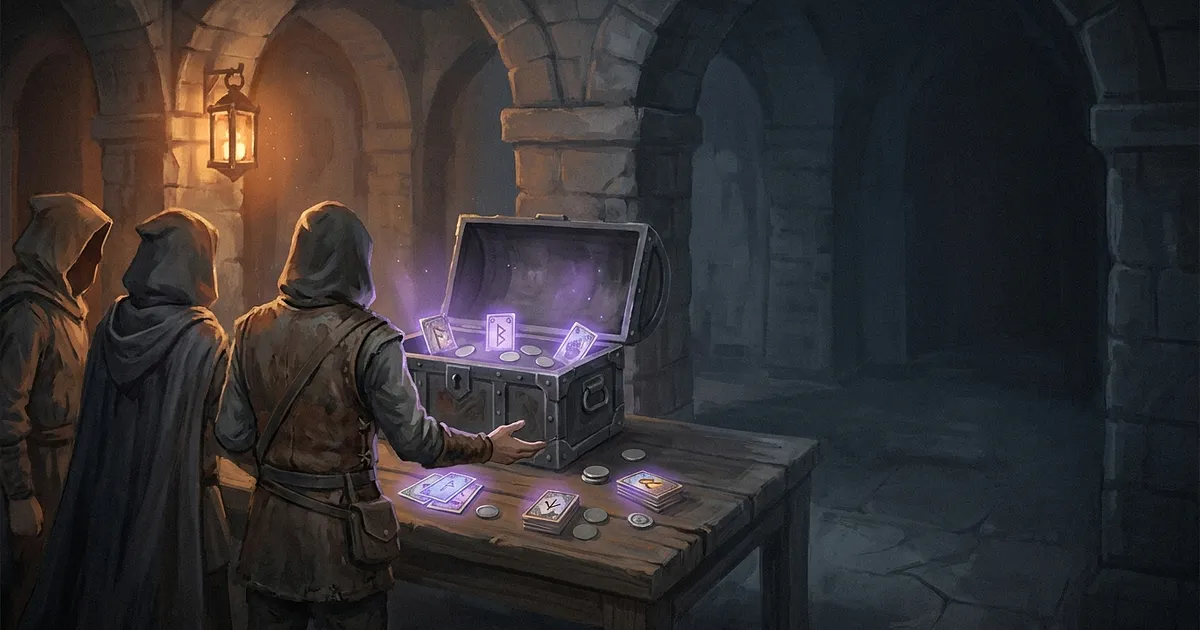
In February 2022, Yield Guild Games (YGG) reported 20,700 Axie Infinity scholars, up from 241 a year earlier (FXStreet, 8 March 2022). In early July 2026, arguably the best-known of all web3 gaming guilds announced it was shutting its game-publishing arm and cutting 35 jobs (Decrypt, July 2026) to chase AI data work instead. From 20,700 scholars to an AI pivot in under five years. That arc tells you most of what you need to know about how guilds worked and why the classic model broke.
What is a web3 gaming guild, and how is it different from an MMO guild?
A web3 gaming guild is an organization that owns or pools crypto game assets and organizes players around them. It handles money. That's the whole difference from the clan you might remember from an MMO.
Your old raid guild probably had a guild bank too. But nobody signed a revenue-share deal over a borrowed sword, and nobody's guild bank had a token trading on exchanges. Web3 guilds run treasuries and payout terms, and many issue a governance token, so they carry financial risk a Discord clan never did.
Why did they exist at all? Cost. Axie Infinity made you own NFT creatures before you could play, and Binance Academy's YGG explainer (updated 14 May 2026) describes the original guild business as lending those assets to players who couldn't afford the entry cost. Naavik's analysts put it bluntly in July 2022: "YGG (and all Web3 guilds for that matter) exists because of Axie Infinity."
A guild usually needs some mix of these people:
Asset owners, meaning the guild treasury or individual investors who buy the NFTs
Managers, who recruit and coach players and take a cut for it
Scholars, the players who borrow the assets and do the grinding
Token holders, who might never open the game at all (yes, really)
Those groups want different things. Keep that in mind, because it's where most of the trouble later comes from.
How do web3 gaming guild scholarships work?
A scholarship is a loan of game NFTs. The owner keeps the NFTs, the scholar plays with them, and whatever the account earns gets split on terms agreed in advance. The scholar puts in time instead of money.
In the Axie era, it looked roughly like this. An owner bought a team of Axies and gave a scholar access to an account holding them. The scholar played daily to farm Smooth Love Potion, or SLP, the game's reward token, then sold their share for cash. A manager sat in the middle, handling recruiting and, at least in theory, coaching.
At its peak this got big. Naavik counted about 30,000 scholars across YGG and its subDAOs by March 2022. The same report found 86% of YGG's scholarships sat in one game, Axie, as of May 2022.
Axie was the whole trade. That concentration is the detail we'd underline: one studio's token decisions sat underneath tens of thousands of people's payouts, and the guild wasn't the one setting them. If you're curious where Axie stands today, that post covers the current player and economy picture.
How does revenue sharing work in a crypto gaming guild?
The split in a crypto gaming guild was whatever the parties agreed to. There was never an industry standard. The best-documented real number comes from YGG itself.
YGG said 70% of the SLP its scholars farmed in February 2022 went to scholars, 20% to scholarship managers and 10% to the guild (FXStreet, 8 March 2022). That's one guild's own aggregate for one month. Other guilds and independent managers set their own terms, and none of it was guaranteed income.
Here's why the percentage matters less than people think. The table below is purely illustrative: made-up round numbers, not a forecast and not a typical earning.
| Hypothetical: 1,000 tokens earned in a month | Share | Tokens | If the token is worth $0.10 | If it drops to $0.01 |
|---|---|---|---|---|
| Scholar | 70% | 700 | $70 | $7 |
| Manager | 20% | 200 | $20 | $2 |
| Guild | 10% | 100 | $10 | $1 |
The split never changed. In that made-up example, the dollar value fell 90%. Nobody broke the deal, and everybody's bag still shrank. A revenue split protects nobody from the token price, and the scholar's hours got spent either way.
To be fair, owners took a hit too, since their NFTs lost value. But owners chose that bet with capital. Scholars mostly chose it with time, and sometimes with borrowed money (more on that below).
Who gets paid when? This is our own analysis of the incentives, not a sourced dataset:
| Who | Puts in | Gets paid from | Hurts most when |
|---|---|---|---|
| Scholar | Hours of play | A share of in-game rewards | The reward token falls or the game cuts emissions |
| Manager | Recruiting and coaching time | A cut of every scholar's output | Scholars quit and volume drops |
| Owner or guild treasury | Capital for the NFTs | Its cut, plus whatever the NFTs are worth | The game's economy collapses |
| Token holder | Money for the guild token | Token price, buybacks, votes | The guild token falls |
How do gaming DAOs and guild tokens work?
A guild is usually pitched as a DAO, meaning decisions are supposed to run through member or token-holder votes. In practice, the governance token's job is the vote. YGG is the reference case for the gaming DAO model, and Binance Academy (updated 14 May 2026) describes its token holders as able to submit and vote on governance proposals. That description doesn't mention any claim on scholarship earnings, and a vote isn't ownership of the guild.
YGG also ran SubDAOs, regional or game-specific units. Per the same Binance Academy page, each SubDAO keeps 70% of its earnings and sends 30% to the main YGG DAO. Don't mix that 70/30 up with the 70/20/10 scholar split. Different layer entirely.
And token holders live in a different economy from players. A scholar gets paid in game tokens for hours played; a token holder gets whatever the guild token trades at. Decrypt reported in July 2026 that YGG's token was down about 99.8% from its $11.17 peak in 2021. We're deliberately not quoting a current price. It'd be stale before you finished reading.
A guild token deserves the same scrutiny as any game token, so our post-crash tokenomics checklist applies here almost line for line.
Why did the scholarship model break?
Because payouts depended on new money coming in, and the new money stopped. Researcher Lars Doucet said it plainly to KR Asia in March 2022: "Play-to-earn is not a sustainable business model if you have more money leaving the economy than is being put into it."
For scholars, that wasn't an abstract chart. KR Asia reported (13 March 2022) that scholar daily earnings had already dropped below the Philippine minimum wage, PHP 537 or about US$10 a day, by August 2021. TIME went further: several scholars it spoke to said they owed "hundreds or even thousands of dollars to friends or family who helped them pay the initial investment, only for their monsters to become worthless." (as summarized by SPIN.ph, 26 July 2022)
The cause was in the emissions. In February 2022, Sky Mavis said four times as much SLP was being created each day as was burned through breeding, and co-founder Jeff Zirlin admitted, "This change should have been made much sooner." The same Decrypt report showed Axie's daily users falling from over 2.7 million in November 2021 to just under 2.2 million by 31 January 2022. SLP went from a peak near $0.40 in August 2021 to about a penny by early February 2022.
Who controlled the faucet? Not the guild. With that 86% Axie concentration above, a web3 gaming guild's whole economy sat downstream of one studio's emission settings. If you want the full sequence of how Axie unraveled, our Axie Infinity crash timeline walks through it, and how play to earn works in 2026 covers what replaced the old reward loops.
What happened to Yield Guild Games in 2026?
In early July 2026, YGG announced it was shutting its publishing arm, YGG Play, and cutting 35 jobs. The YGG Play site and launchpad closed after 31 July 2026, and games like LOL Land were retired. The company now pitches itself around AI data work.
Co-founder Gabby Dizon called it "a market decision, not a product decision" (Decrypt, July 2026). YGG also told Cointelegraph (7 July 2026) that the 10 October 2025 crash "fundamentally altered retail market psychology," and that it didn't expect the crypto consumer and Web3 games publishing markets to "recover sufficiently in the near term."
Not dead, though. YGG reported over $9 million in lifetime YGG Play revenue through Q1 2026 (Decrypt, July 2026). Separately, it put its treasury at $20.6 million at the end of Q1 2026, which Decrypt describes as about four years of runway. All of those are company-reported figures. YGG isn't alone in the wreckage either; our piece on the wider 2026 GameFi shutdown wave covers the sector-level picture.
The route from scholarship guild to here, in dated steps:
- 2021 to early 2022: Axie scholarships at scale, 20,700 YGG scholars by February 2022.
- 20 November 2024: YGG launches Onchain Guilds on Base, group tooling for onchain reputation and shared assets (Decrypt).
- 30 September 2025: the original vault programme ends, and Binance Academy (May 2026) says the blanket scholarship model was later phased out for a merit-based questing system.
- August 2026, after the YGG Play shutdown: "YGG 3.0" switches on, with 105 Onchain Guilds and 11 regional partners per egamers.io (17 August 2026).
As of 10 October 2026, YGG's own homepage calls it "The world's original Web3 guild, now powering frontier AI." Read that twice.
Are web3 gaming guilds still useful after the crash?
Smaller and different, yes. As a way to earn a living, the sources above don't show that they are. The scholarship business is mostly gone; what survives, per the Binance Academy, Decrypt and GamesTX pieces linked here, looks like quest platforms, onchain community tooling and player acquisition for game studios.
The Blockchain Game Alliance's 2025 industry survey points the same way. As quoted by Bitpinas in December 2025, guild leaders and esports professionals made up 7.9% of respondents, down from 20.7% in 2022. Big caveat: that's a share of a self-selected survey (506 valid responses, collected August to October 2025), not a count of guilds or players. It's a mood reading, not a census.
Analyst Jon Jordan's GamesTX piece from 24 April 2024 is still the clearest description of the shift. Guilds were "stepping up, becoming engagement platforms for the entire sector," he wrote. But "stripping out the web3 rewards, the underlying business model here is just user acquisition," and he questioned whether that's a long-term solution.
So, are web3 gaming guilds still useful? When they teach and organize players, we think yes. When the pitch leans on what you'll earn, no. The wider web3 gaming crash took most of the earning pitch with it, and we don't expect it back soon.
Community and training: the part that aged best
The original pitch wasn't only about money. It was about getting new players in, then coaching them until they could stand on their own.
YGG co-founder Gabby Dizon was quoted by Decrypt in August 2021: "The expectation is that the new player, or scholar as they are known, will earn enough from playing the game to be able to 'graduate' from the program and eventually buy their own NFTs." The earning half of that sentence didn't survive 2022. The graduating half, people learning how wallets and game economies actually work, is probably the most durable thing guilds ever offered. If you'd rather start without a guild, our zero-wallet starter checklist is the do-it-yourself route into the same basics.
Honestly? That's still the best reason to look at one. Wallet habits and game-economy sense stick with you. A token price doesn't.
What are the risks and conflicts of interest?
Web3 gaming guilds carry a few, and a lot of them land on the player rather than the guild.
You don't own anything. As a scholar, the NFTs and often the account belong to someone else, who can revoke access whenever the terms allow (or whenever they feel like it, if nothing's in writing).
Price risk lands on the person putting in hours, too. Look back at the hypothetical table above. Same split, a tenth of the money.
Managers get a cut of volume. In YGG's reported split, managers took 20% of what their scholars farmed, so more scholars means more cut even if each one earns less. Naavik's July 2022 report found "increases in scholars are not leading to increases in revenues" at YGG.
Guilds can also invest in the games they push. Naavik counted 62 investment deals for YGG by mid-2022. That doesn't make any recommendation dishonest, but when a guild tells you a game is great, it's fair to ask whether it also holds that game's token.
Then there's the fairness question. In a 2026 paper in the International Journal of Communication, researchers Joy Hannah Panaligan and Jonalou Labor argue blockchain gaming can be both a site of liberation through "economic empowerment and a space of imagined better futures, while also possibly masking underlying reinforcement of colonial legacies." That's the authors' argument, not a ruling, but it's worth reading if you've ever wondered who carried the risk in a scholarship.
Tax is the boring one people skip. Earnings from game tokens may be taxable where you live, and the rules vary a lot by country, so a local tax professional is the right call here, not a Discord mod.
Scammers can borrow the word "guild" too. Anything asking for an upfront fee to "unlock" a scholarship should go through our rug-pull red flags check before you send a cent.
Does a guild add real value? A checklist before you join
These are the questions we'd want answered before joining any web3 gaming guild. Not every guild will pass all of them, and that's fine. The point is knowing which ones it fails.
Who owns the assets, and who eats the loss if prices fall?
Are the split and the exit terms written down? Can you leave with what you've already earned?
Does the guild make its money from gameplay, or mostly from selling you its token?
Is there a treasury figure you can actually read? YGG reported $20.6 million at the end of Q1 2026 (Decrypt, July 2026). If a guild can't show you a number, ask why.
Upfront payment, a lock-up or an income promise... any one of those is a red flag, and a deposit before you've played a minute looks a lot like a rug with extra steps.
Does the game's reward token have real sinks, or is it minted faster than it's burned, the way SLP was in early 2022 (Sky Mavis, February 2022)?
Is the actual offer training and community? That part can be worth something even with zero rewards attached. Run the guild's Discord past these web3 game Discord red flags before you trust it.
If a web3 gaming guild's best argument is the payout, walk away. Ngmi. If it's the people and what they'll teach you, that's a guild in the old, pre-crypto sense of the word, and in our view that kind never needed a token to be worth joining.
This post is information only. It isn't financial or tax advice, and nothing here promises any income from any game or guild.
Frequently Asked Questions
Can you join a crypto gaming guild for free?
Some guild communities and quest platforms don't charge to join, and Binance Academy describes YGG's original lending model as aimed at players who couldn't afford the NFTs. Free to join isn't free of risk, though: your time can go into a token that loses value. Any guild asking for an upfront fee or a locked deposit before you play deserves extra scrutiny.
Do guild token holders really control a gaming DAO?
Only as far as the voting process allows. Binance Academy describes YGG token holders as able to submit and vote on governance proposals. Nothing in that description makes a governance token a share of scholars' earnings, and a vote isn't ownership of the treasury or the NFTs.
How do web3 gaming guilds make money now?
The picture is thin and it varies. Analyst Jon Jordan wrote in April 2024 that, minus web3 rewards, the underlying guild business is "just user acquisition," with quests that onboard players for game developers. YGG itself moved from lending Axies to onchain guild tools and, in 2026, to AI data work.
Is play-to-earn dead?
The 2021 version, where scholars farmed a token for daily income, has largely faded, as the Axie numbers above show. Binance Academy says YGG swapped blanket scholarships for merit-based questing. Any reward is reported as it happened, never guaranteed, so treat a game or guild pitched mainly as an income source with real skepticism.
Did Yield Guild Games shut down?
Not entirely. In July 2026 it shut its publishing arm, YGG Play, and cut 35 jobs, according to Decrypt. YGG says it is pivoting to AI data work, and it reported a $20.6 million treasury at the end of Q1 2026, which Decrypt describes as roughly four years of runway. Those are company-reported figures.
Sources
- 20,700 Axie Infinity scholars, up from 241 a year earlier fxstreet.com
- shutting its game-publishing arm and cutting 35 jobs decrypt.co
- Binance Academy's YGG explainer binance.com
- "YGG (and all Web3 guilds for that matter) exists because of Axie Infinity." naavik.co
- KR Asia in March 2022 kr-asia.com
- "hundreds or even thousands of dollars to friends or family who helped them pay the initial investment, only for their monsters to become worthless." spin.ph
- four times as much SLP was being created each day as was burned through breeding decrypt.co
- Cointelegraph cointelegraph.com
- launches Onchain Guilds on Base decrypt.co
- 105 Onchain Guilds and 11 regional partners egamers.io
- YGG's own homepage yieldguild.io
- Bitpinas in December 2025 bitpinas.com
- GamesTX piece from 24 April 2024 gamestx.substack.com
- Decrypt in August 2021 decrypt.co
- argue blockchain gaming can be ijoc.org