What Is a Crypto Trading Card Game? How On-Chain TCGs Work
 15 min read
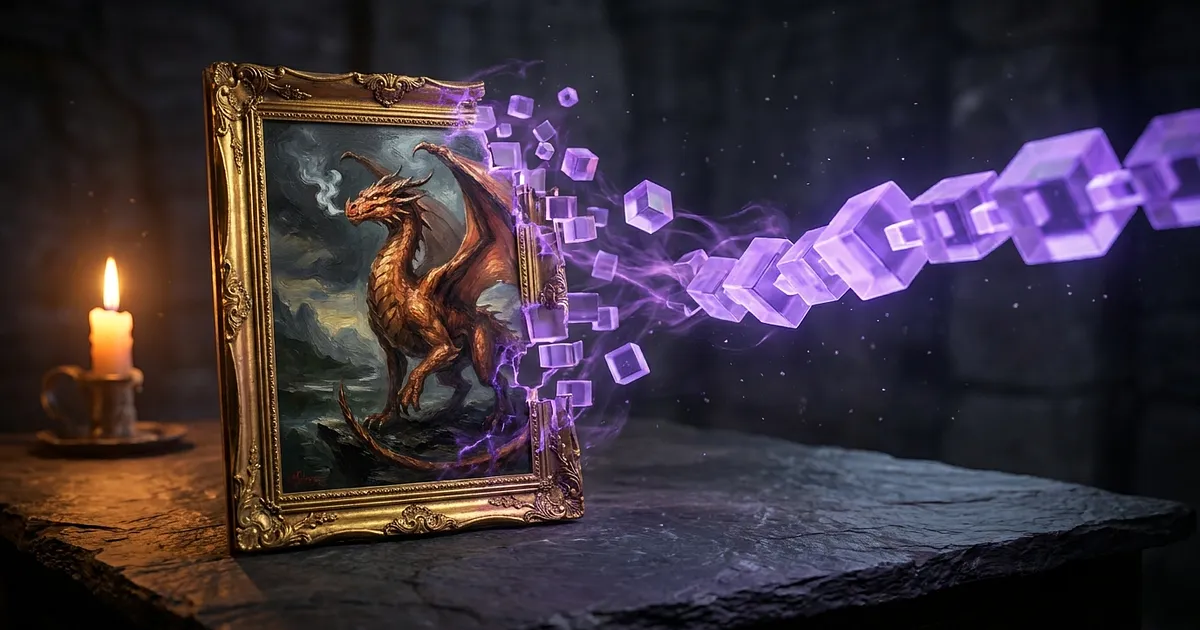
gm. The blockchain doesn't play your match. In the games that spell out their setup, the battles run on an ordinary company server, same as Hearthstone, and the chain just keeps the ownership record: which wallet has which card, and every time one changes hands. That one fact clears up most of the confusion around the crypto trading card game, a genre that has spent years being sold as "own your cards forever."
That split is useful. It's also where most of the risk hides, and the marketing rarely says so.
What is a crypto trading card game, exactly?
It's a digital TCG where your collection lives on a public ledger instead of only in the developer's database. Everything else is just a card game: deckbuilding, ranked ladders, new sets, endless arguments about which card is broken.
You'll see the same thing called a blockchain card game, a crypto TCG, crypto card games, NFT card games, web3 card games or an on-chain TCG. Mostly interchangeable. (That last one can also mean something else, covered next.)
Each card is usually an NFT. Under the ERC-721 standard, a token is identified by its contract address plus a token ID, and the contract's ownerOf function tells anyone which wallet holds it. Name, art and stats normally sit in metadata the token points to through an optional tokenURI.
We'd describe the token as a receipt the whole internet can read. A useful receipt. Still a receipt.
Is an on-chain TCG the same as tokenized Pokémon or Cardsmiths cards?
No. Searching "crypto trading cards" or "on-chain TCG" can land you on either of these, and neither is a game whose cards you battle with.
Tokenized cards are physical. The Block defines tokenized collectibles as "physical cards vaulted with a third-party custodian and backed by an NFT redeemable for the physical card," and counted $5.38 million in weekly revenue across Pokémon TCG marketplaces for the week ending 6 April 2026.
Cardsmiths' Currency cards are paper packs, some with crypto inside. Decrypt reported in November 2025 that roughly 1 in 96 packs of Currency Series 5 held crypto through redemption codes, according to the product page. No game, no on-chain cards. If that's what you searched for, wrong post, no hard feelings.
What lives on-chain, and what stays on the studio's server?
Ownership and transfers go on-chain. Matchmaking, the rules engine and, as far as the games that document their setup go, the match itself run on the studio's own servers.
Not a new discovery. Around the Gods Unchained launch, MIT Technology Review reported in July 2019 that blockchain, "notoriously slow and inefficient at processing transactions," "will only be used to keep track of the cards and who owns them," and that the actual game "will be played 'off-chain.'" Splinterlands described the same split in its own 2021 update (more below).
| Part of the game | Where it usually lives | What that means for you |
|---|---|---|
| Who owns which card | On-chain, as an NFT | Anyone can verify it; you can usually move or sell it |
| Transfers and marketplace trades | On-chain | Public record of every trade; fees and gas (network fees) may apply |
| Card name, art and stats | Metadata the token points to | Hosted wherever the studio chooses |
| Matchmaking | Studio server | The studio decides who you play |
| Rules engine and match logic | Studio server, in most games | A balance patch can rework your cards overnight |
| Pack and match randomness | Varies: server RNG, block hash or verifiable RNG | Worth checking per game (see below) |
| Game client, deck builder, account | Studio server or app | If the servers shut down, this goes with them |
So your card is a line in a public ledger. Everything that makes it do something in a fight belongs to the studio. Some games also hand out cards you can't trade at all, a wrinkle covered in our soulbound tokens explainer.
How do crypto trading card games work? Four real examples
Same split in all four of these crypto card games. The differences are the chain, the wallet question, and how much the studio has moved things since launch.
Gods Unchained: Ethereum cards that changed chains
Gods Unchained cards started as Ethereum tokens traded through Immutable X. In April 2025 Immutable announced it would fold Immutable X into Immutable zkEVM, and Gods Unchained went along. Its migration FAQ, dated 11 April 2025, says tradable NFTs would keep their token IDs and the trading fee would stay at 9%. We covered what the Immutable merger changed for Gods Unchained players in more detail.
The platform moved, so the cards moved. The chain is still a studio decision.
Bit of archaeology while we're here. A 2018 reading of the original Gods Unchained contracts found that cards only became ERC-721 tokens once the owner redeemed them, to save gas. So in that launch-era design, a card you'd paid for wasn't a token until you paid again to claim it.
Splinterlands: signed moves on Hive, battles on the server
Splinterlands' docs say its cards are NFTs built on "web 3.0 technology powered by the Hive blockchain." In its August 2021 scaling update, Splinterlands moved five battle operations, matchmaking and team submission among them, off the chain and onto its own servers. Players still sign those actions with their Hive keys, and the studio said it would "publish the results of each battle back to the Hive blockchain" so the game's state stays publicly verifiable.
It also called the results "provably fair," which is Splinterlands' own claim about signed inputs, not an outside audit. And that post is from 2021, so details may have changed.
Parallel: the token is optional
Parallel's FAQ says each card is represented by a Digital Collectible (ERC-1155, a multi-token standard) "on the Ethereum network," that the game is free to play, and that it "does not require a web3 wallet."
So the game account and the token are separate layers, and you can play without touching the second one. The FAQ also says owning the collectible gives you "the opportunity to earn PRIME," Parallel's token. That's the project's pitch, not a reason to buy.
Cross the Ages: free to play, then a chain swap
In June 2023, Decrypt's beginner guide said you could play Cross the Ages completely free without a crypto wallet, with minting a card as an NFT optional.
Then the game left Immutable for Solana. Blockchain Gamer reported in August 2025 that the migration was done and that assets remaining on Immutable "will be frozen by Immutable." That 2023 no-wallet description predates the redesign.
Four games, one skeleton. Two of them have already switched chains.
Is the randomness in a blockchain card game fair?
Sometimes you can check it, often you can't. It depends on how the game generates its randomness, and you usually have to dig to find out.
If a server rolls the dice for your pack or your match, you're trusting the server, crypto trading card game or not. The on-chain options each come with a catch:
Block hash. The 2018 Gods Unchained contract reading found packs got their randomness in a second step, from the hash of the block containing the purchase, and that "anyone can call the callback function," so the studio couldn't stall on a roll it disliked. Launch-era design; we found no 2026 statement of how Gods Unchained packs work today.
Commit-reveal. Each party commits to a hidden value and reveals it later. Chainlink's February 2026 explainer flags the catch: whoever reveals last sees everyone else's value first and can hold back their own if the outcome looks bad.
Verifiable random functions. Chainlink, which sells a VRF service (small grain of salt), describes VRF as a generator whose proof "is published and verified onchain before any consuming applications can use it."
Signed inputs plus published results. The Splinterlands model above. Inputs are verifiable; the battle math still happens on the studio's machines.
If "provably fair" still reads like a sticker on a box, our explainer on provably fair games breaks down what's being proven.
Where Stellarch fits, and where it doesn't
Stellarch, a browser TCG on Hive, takes the deterministic route. Combat runs on a seeded-RNG engine, so any match replays identically from its seed: same teams, same ruleset, same seed, same winner. Nobody has to trust that a server rolled fairly, because the result can be replayed from the seed instead of taken on faith. That's what provably fair should mean: you can check the math yourself.
It's free to start, too. No card purchase and no crypto wallet are needed to play your first match, since sign-up works with email or Google, and it runs in the browser with no download. Cards are called Fighters, and a fresh account drafts a full team from a free starting pool.
Now the concessions, because they're real. Splinterlands is also on Hive and wins on player base and track record, full stop. A new game doesn't match that. Gods Unchained has the bigger production values and marketing budget, and it's free to start in the browser too. And Stellarch is an alpha, not a full launch, so the honest next step is to see where access stands at stellarch.io. We're pointing at it for its fairness model, not for any earnings story.
What does a first-timer have to deal with?
Usually a wallet, maybe gas, a marketplace fee on trades, and the job of keeping your keys away from scammers.
The typical path into a crypto trading card game: you make a game account, and at sign-up or your first trade the game asks you to connect or create a wallet. Some games give you an embedded wallet tied to an email login; others expect you to bring your own and guard a seed phrase, and losing that phrase means losing the cards. Our guide to crypto game wallets walks through that choice.
Then there's gas, the network fee for writing anything to the chain. In December 2023 Immutable's product marketing lead told Decrypt that web3 games must make "the blockchain components as effortless and native as possible," and Immutable lets developers sponsor gas for players on its Passport wallet. Gods Unchained is the example: its April 2025 migration FAQ promised gas-free transactions through Passport, a small IMX gas fee for standard wallets, and a 9% trading fee.
The boring risk is the biggest one. Ethereum.org says NFT security problems are "most often related to phishing scams, smart contract vulnerabilities or user errors." Think fake "claim your free pack" links and signature requests nobody read. Losing a ranked match costs you some rating. Signing one blind transaction can cost you the wallet.
Are NFT cards worth anything?
Some are, plenty aren't, and nobody can promise which. A card's value depends on a game that's still alive and on buyers who want it, minus the fees in between, and the token alone guarantees none of that.
Start with the ugly base rate. A 2023 dappGambl analysis reported by The Register found 69,795 of 73,257 NFT collections, 95%, had a market cap of zero. That counted every kind of NFT, not just NFT card games, and it's three years old, so treat it as a mood, not a measurement.
Here's the part that bites. Owning the token proves you hold the record. It doesn't make the studio keep the game running, the marketplace open or the chain supported.
2026 delivered the cleanest example. Ubisoft's Champions Tactics, a tactics RPG rather than a card game but the same model, launched in October 2024 with every unit an NFT, according to TBreak. TBreak says Ubisoft moved it away from blockchain features in May 2026, and Ubisoft has since set the server shutdown for 30 October 2026. After that date there's no game left to use those units in. Not a rug in the classic sense (it was announced, not a disappearing act), but your bags go dark either way.
Add Cross the Ages' frozen leftovers and Gods Unchained's chain move, and the pattern is hard to miss: the studio holds the keys, not you.
If you're eyeing cards as income, read how play-to-earn works before you ape in. The economics are rougher than the trailers.
Before you ape into any crypto trading card game, here's what we'd want answered:
Is the game alive? Recent patches, populated matchmaking, a studio that still posts.
Can you sell? Completed sales beat listing prices, which are mostly wishful thinking.
What does the round trip cost in fees and gas, buying and selling?
Who controls the chain, and has the game moved before? Two of the four examples above already have.
Would you still buy it if it were worth zero next year?
For a fuller pre-purchase routine, see our five-question NFT checklist. The last question does most of the work. DegenLoot can't predict card prices, and nothing here says any card will hold its value.
Crypto card games or Hearthstone and MTG Arena: what do you gain?
You gain a tradable, publicly verifiable ownership record. You give up polish and simplicity, which is why we think the normal games are the better product for most people who just want to play cards.
Wikipedia's Hearthstone entry says the game "was designed early on without any trading system between players," so you get cards from packs or by crafting with arcane dust. Its MTG Arena entry says Arena has no player-to-player trading either. That's the price of the smoother experience.
What a crypto trading card game adds:
Real resale and trading, at least while a market exists
A public ownership record nobody can quietly edit
Sometimes, randomness you can verify, depending on the game
In theory, cards other apps on the same chain can read, though whether another game honours your card is a separate question
What it costs you:
Usually smaller player pools than the mainstream card games
Wallets, keys and a steady supply of phishing attempts
Fees and gas on trades
Exposure to chain moves, token swings and shutdowns
Hot take, no hedging: the crypto version only wins if tradable ownership or checkable fairness matters to you. If neither does, Arena is right there, and nobody will ask for your seed phrase.
Who is a crypto trading card game for?
A crypto trading card game suits players who already think in trades and card markets, and who'd rather check randomness than trust it. One more requirement, and it's the one that matters: you have to be fine with the whole collection going to zero if the studio walks away. Can a card go to zero? Yes. Plan like it will.
Still in? Next up: our crypto TCG deck-building guide.
Frequently Asked Questions
Do I need a crypto wallet to play a crypto trading card game?
Not always. Parallel's FAQ says its game does not require a web3 wallet, and Stellarch's sign-up works with email or Google. Many other games ask for a wallet at sign-up or at your first trade, so check each game's onboarding page.
Can the developer take my cards away in a blockchain card game?
The token usually stays in your wallet, but the studio controls what makes it useful: the balance, the chain, the marketplace and the servers. Ubisoft has set the Champions Tactics server shutdown for 30 October 2026, for example. Owning the record is not controlling the game.
Can you make money playing a crypto TCG?
Sometimes you can sell cards or reward tokens, but nothing about it is reliable or guaranteed. A 2023 dappGambl analysis found 95% of all NFT collections, not only game cards, had a market cap of zero, and fees and gas come off every sale. Budget for it as money spent on a game.
What is the difference between an on-chain TCG and tokenized Pokémon cards?
An on-chain TCG card is a digital card you play with inside a video game. A tokenized Pokémon card is a physical card stored in a custodian's vault, represented by an NFT you can redeem for the real card. Same buzzword, completely different product.
Is pack randomness in a blockchain card game fair?
It depends on the game. Server-side randomness asks you to trust the studio, while block-hash, commit-reveal and verifiable random function designs let outsiders check more, each with known weaknesses. A seeded deterministic engine lets any match be replayed from its seed for the identical result.
Sources
- ERC-721 standard eips.ethereum.org
- The Block theblock.co
- Decrypt reported decrypt.co
- MIT Technology Review reported in July 2019 technologyreview.com
- announced it would fold Immutable X into Immutable zkEVM decrypt.co
- migration FAQ, dated 11 April 2025 portal.godsunchained.com
- 2018 reading of the original Gods Unchained contracts hackernoon.com
- Splinterlands' docs docs.splinterlands.com
- scaling update peakd.com
- Parallel's FAQ parallel.life
- ERC-1155 eips.ethereum.org
- Decrypt's beginner guide decrypt.co
- Blockchain Gamer reported in August 2025 blockchaingamer.biz
- Chainlink's February 2026 explainer chain.link
- Chainlink docs.chain.link
- stellarch.io stellarch.io
- Decrypt decrypt.co
- Ethereum.org ethereum.org
- 2023 dappGambl analysis reported by The Register theregister.com
- TBreak tbreak.com
- set the server shutdown for 30 October 2026 videogameschronicle.com
- Wikipedia's Hearthstone entry en.wikipedia.org
- Its MTG Arena entry en.wikipedia.org