NFT Interoperability: Why Your Sword Still Cannot Travel Between Games
 11 min read
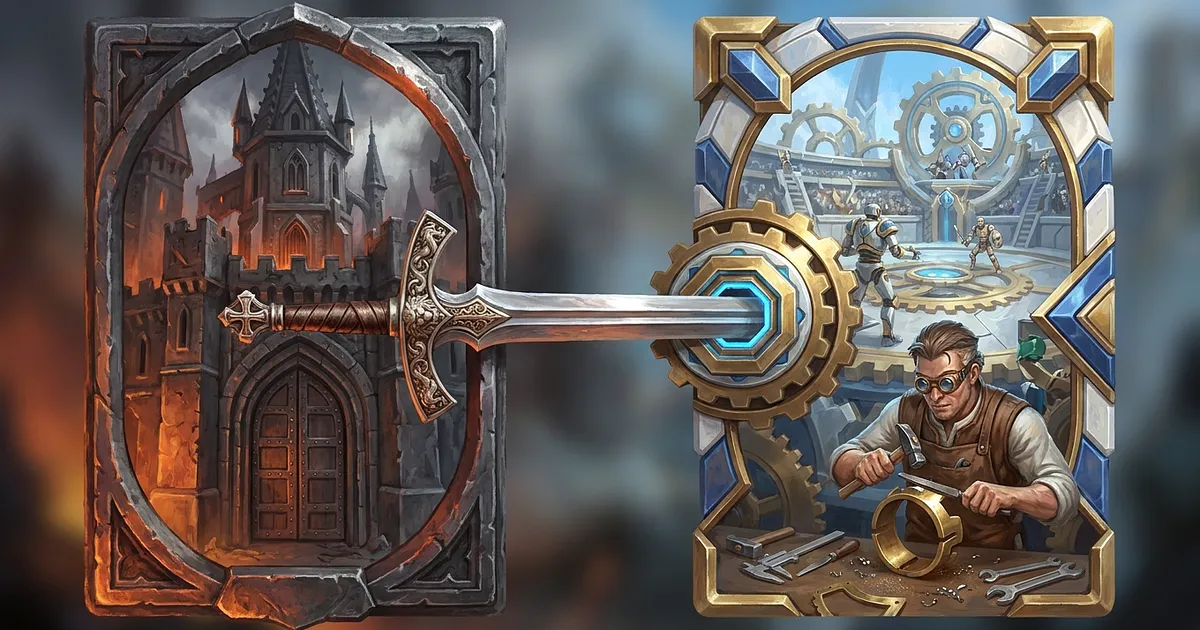
The chain can prove you own the sword. Open a second game, though, and it is still an ignored contract address. That studio has to supply the model, movement, combat rules, balance, and permission to use the art. NFT interoperability begins with ownership proof. It does not end there.
Limited, supported interoperability can work. The problem is the universal version sold in pitch decks, where any item supposedly walks into any game because both projects use NFTs. A receiving studio has to build a specific integration and keep it alive.
Why NFT interoperability is more than ownership
An NFT is closer to a claim ticket than a packed game object. The chain can record an owner, contract address, and token identifier. Metadata may attach a name, traits, or a media link. None of that forces a game client to accept the collection or create a local sword from it.
The standards are narrower than the marketing. ERC-721 describes basic functionality for tracking and transferring non-fungible tokens. Its metadata extension is optional and provides a URI. It does not define weapon classes, hitboxes, rarity curves, equip slots, crafting recipes, or combat timing.
ERC-1155 can represent several fungible and non-fungible token types through one contract. The standard explicitly says it is not specific to games. Useful plumbing, yes. Combat design, no.
A field such as strength: 90 exposes the gap. Ninety strength might be weak in one RPG, absurd in a tactical game, and meaningless in a social world with no combat. Matching field names do not create matching units, progression systems, status effects, or economies.
Marketing usually compresses five separate layers into the word "interoperable."
| Layer | What can travel or be queried | What the receiving game still decides |
|---|---|---|
| Token | Contract, token ID, owner, approvals | Whether it accepts the collection |
| Metadata | Name, traits, media URI | Which fields it trusts and what they mean |
| Media | Model, texture, image, audio | Scale, rig, collision, effects, performance budget |
| License | Stated permissions for the associated work | Whether the studio may reproduce or adapt it |
| Gameplay | Nothing universal | Local class, abilities, damage, progression, balance |
Transferability is a prerequisite, not proof of game support. Our guide to soulbound tokens and game-item ownership covers that earlier boundary. Removing a transfer restriction still leaves every destination decision in the table.
The NFT interoperability test for receiving games
Forget the abstract claim for a moment. Interoperable between which named games, and at which layer? The useful test starts with the destination and works backward.
The token has to survive the trust check
The receiving game needs the correct network, contract, token ID, and current ownership state. It also needs rules for burns, transfers during play, wrapped representations, and any delegated right to use the item. A contract allowlist sounds boring. Boring beats accepting a spoofed collection that copied the original name and image.
Readable metadata is not automatically meaningful metadata. The destination needs a supported schema and a fallback for fields or media that change or disappear. ERC-721 itself permits a mutable URI. That means the consumer has to validate what it reads rather than treating yesterday's response as a permanent game design.
Then comes the semantic mapping. Perhaps weapon_type=sword becomes a cosmetic skin. Maybe a named collection grants access to a room. Turning an external trait directly into combat power is a much larger promise because another project can alter data that now affects local balance.
The receiving game still has to build the item
A picture of a sword is not a game-ready sword. A model can load at the wrong scale, point the wrong way, or use a skeleton the destination cannot animate. Collision and performance budgets come after that. Even first-person and third-person views may need different versions of the object.
A common file format helps with transport. The glTF 2.0 specification calls glTF an asset format and says it "does not mandate any runtime behavior." A file can load correctly while doing absolutely nothing.
The Metaverse Standards Forum's 3D asset report treats materials, physics, behavior, format conversion, and animation as separate work areas. "We support glTF" answers one file-pipeline question. It does not tell you whether the sword can swing.
Now the studio creates the local object. A source sword might become a skin, access key, crafting ingredient, badge, or balanced starter weapon. Each choice can be honest if the project names it. The token did not arrive with universal mechanics tucked inside.
This is also where the new guide stays separate from title-specific ownership coverage. What Off The Grid NFT ownership includes is about one game's supported utility. The receiving-game test asks how any second title would define its own utility for an external item.
The safest mapping usually preserves identity while remaking function. Players get recognition for holding the source asset; the destination keeps control of damage, cooldowns, progression, rarity, and its economy. Purists may call that watered down. Game designers call it not wrecking the game.
Compatibility also needs an owner after launch. Contracts migrate, metadata hosts disappear, and engines update. Collections get compromised or abandoned. Someone still has to monitor the adapter, support players, and decide how it fails when the source project goes dark.
Not sexy. Very real.
Same chain, bridges, and portable art solve different problems
For cross-game assets, putting two games on the same blockchain makes ownership queries easier. It may also let contracts interact without crossing networks. The games still need an agreement about item identity, metadata meaning, art, and behavior. Shared infrastructure is not a shared rulebook.
A bridge solves a network problem. Chainlink's NFT games explainer separates same-chain connectivity from blockchain-to-blockchain interoperability, while noting that games commonly combine smart contracts with traditional servers. Moving or representing token state elsewhere does not supply the receiving game's item code.
The rebuilt infrastructure in our Ronin bridge and migration explainer concerns network continuity, not arbitrary items gaining support in every Ronin game. If a sword appears on another network and no game there recognizes its contract or maps it to a local object, the bridge delivered the receipt. The game still has no sword.
Wallet display is no better as proof. A UI can show that an address owns an NFT without importing it into play. Marketplace trading proves that buyers and sellers can exchange the token. Neither demonstrates a renderer, item definition, or server rule.
Rights are another stop sign. The joint NFT study by the U.S. Copyright Office and USPTO was submitted to Congress on March 12, 2024. It reports widespread concern that NFT buyers and sellers do not know which intellectual-property rights are involved in creating, marketing, and transferring NFTs. A contract address is not a blanket art license.
Projects can grant permissions through an explicit license. But a license and a token standard do different jobs. ERC-721 can identify the token owner. The license governs permitted uses of the associated work. A destination studio needs a technical path and the relevant legal permission.
Two bounded examples show what works
Real game item interoperability looks less magical and more like an adapter with rules. Good. Bounded claims can be checked.
Decentraland uses local representations
Decentraland's Linked Wearables documentation describes a deliberate path for representing external ERC-721 or ERC-1155 holdings as avatar wearables. A creator identifies the network and contract, links token IDs, supplies prepared 3D files and configuration, then submits the items through publication and curation.
The wording matters. These are in-world representations linked to external NFTs. The token does not teach Decentraland how to dress an avatar. Ownership is the eligibility check; Decentraland gets a local asset built for its body shapes and content rules.
This is architecture evidence, not a claim about current client availability. It shows the shape of one supported integration: a named collection, mapped IDs, prepared art, local configuration, and platform approval. It does not show that every NFT can become a wearable.
Loot leaves interpretation to builders
Loot's official site takes almost the opposite route. Its base items intentionally omit stats, images, and other functionality for others to interpret. That minimalism makes the shared primitive easier to reuse. Every builder still decides what a named item looks like and what it does.
The community-maintained Loot.foundation documentation describes a shared foundation, physics, and core principles for a coherent Lootverse. There is the catch. Open interpretation still needs agreements when progression or behavior should line up across experiences.
Loot demonstrates several deliberate interpretations, not universal item execution. A text primitive can inspire different games precisely because it does not drag one combat model into all of them. Less prescribed behavior may make coordination easier. It does not make integration vanish.
Audit cross-game NFTs with proof, not vibes
Claims about interoperable game NFTs should name actual systems and actual behavior. "Multichain," "ERC-721 compatible," and "metaverse-ready" are not complete answers.
| Proof to request | A useful answer | A weak answer |
|---|---|---|
| Games and identity | Both titles, network, contract, collection, token range | "Any NFT in partner worlds" |
| Verification | Current ownership check and transfer handling | Wallet screenshot |
| Mapping and asset | Supported fields, schema, local file requirements, fallback | "Reads metadata" |
| Local behavior | Cosmetic, access, class, or locally mapped stats | "Same item everywhere" |
| Rights | Named license or studio agreement | Token ownership alone |
| Safety and upkeep | Limits, revocation, responsible team, failure behavior | Launch demo only |
Start with the blunt check: name the second game and show the item working there. Then ask what survived. Identity or appearance? Access or mechanics? Progression too? "The sword travels" could describe a wallet badge or a fully animated local weapon. Those are not remotely the same promise.
The broader NFT buying checklist covers the contract, project, price, and purchase pitch. This matrix has a narrower job. It tests whether a named destination did the art, mechanics, balance, rights, safety, and support work needed to honor one portability claim.
A community mod can be fun without being maintained platform support. A one-off event skin proves one bounded integration, not a permanent open standard. A promotional render proves even less.
And ask how the integration fails. Can the destination freeze a known-safe asset when metadata changes? Can it revoke a compromised collection? Does missing media become a placeholder instead of a broken character? A project without answers has a demo and an unopened maintenance tab.
The honest version is deliberately limited
"ERC-721 compatible" is infrastructure, not a gameplay demo. For credible NFT interoperability, a named second game has to ship and maintain the mapping. Until then, keep the sword in the wallet and the claim in the marketing folder.
Frequently Asked Questions
Can an NFT item be used in any blockchain game?
No. A game must recognize the token and map it to local art, behavior, balance, and permissions. A standard contract can make identity and ownership queryable, but it cannot force an unrelated game to support the item or keep that support working.
Does using the same blockchain make game assets interoperable?
No. Shared infrastructure makes contract and ownership queries easier. The games still need compatible schemas, supported assets, local mechanics, rights, safety rules, and continuing developer support. Same-chain access removes one transport hurdle; it does not build the destination item.
Can a cross-chain bridge make my NFT work in another game?
A bridge can move or represent token state on another network. It does not provide the destination game's model, animation, item definition, balance policy, or contract mapping. The receiving game still needs to support that representation and assign it a local role.
What has to match before two games can share an item?
NFT game interoperability needs an agreed identity, ownership rules, trusted metadata, supported media, legal permissions, local behavior, balance limits, safety checks, and a maintenance plan. A cosmetic mapping can still be genuine interoperability when the project states that limit clearly.
Can the sword keep the same stats in both games?
Only if both developers adopt a shared stat model and decide the values fit each game. More often, the destination preserves the item's identity or appearance while assigning local stats that suit its own combat system, progression, and economy.
Is glTF enough to make a 3D NFT playable everywhere?
No. glTF can carry a 3D asset, but it does not define runtime behavior. Each game still controls scale, rigging, collision, physics, abilities, effects, equipment rules, and performance limits. A portable file is useful; it is not a portable rulebook.
Sources
- ERC-721 eips.ethereum.org
- ERC-1155 eips.ethereum.org
- glTF 2.0 specification registry.khronos.org
- Metaverse Standards Forum's 3D asset report metaverse-standards.org
- Chainlink's NFT games explainer chain.link
- joint NFT study by the U.S. Copyright Office and USPTO copyright.gov
- Decentraland's Linked Wearables documentation docs.decentraland.org
- Loot's official site lootproject.com
- Loot.foundation documentation docs.loot.foundation