Parallel TCG Banking: Which Card Becomes Your Next Energy?
 11 min read
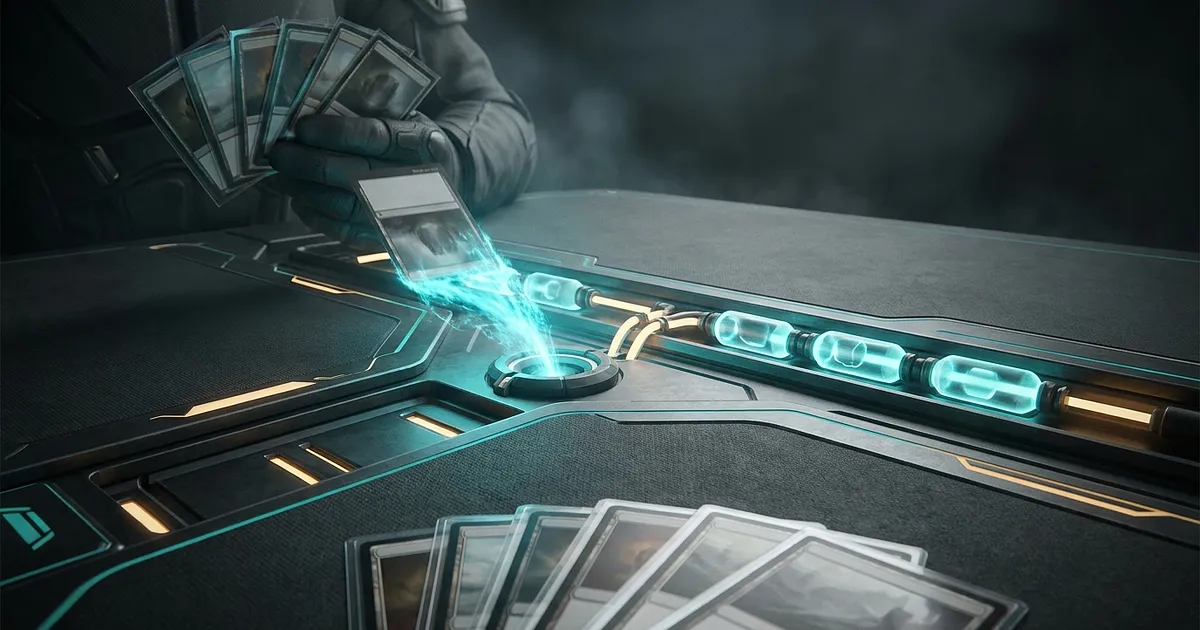
Parallel TCG banking asks a nastier question than "Do I need more Energy?" It asks which known card you can afford to lose. Banking raises your Max Energy, up to the 10 Max Energy Banking limit, and gives you one Energy now. The card leaves your hand. Protect the play you need, then convert the option doing the least work.
This is a decision guide, not a match-data report. Every hand below is hypothetical. No games were observed, no deck was tested, and no named card effect or current metagame claim is being passed off as fact.
What Banking actually trades
The official Parallel TCG Game Manual defines the exchange precisely. You move a card from your Hand to the Bank, your Max Energy rises by one, and you gain one available Energy immediately. The normal Bank action is limited to once per turn. Banking can take you only up to 10 Max Energy.
That action changes two values:
| Value | What changes when you Bank | Why it matters |
|---|---|---|
| Max Energy | It increases by one | Your available Energy can refresh to this higher ceiling on later turns |
| Available Energy | You gain one immediately | A card that was unaffordable may become playable during the current Main Phase |
Banking moves both numbers, but they do different jobs. Max Energy sets the ceiling. Available Energy pays for the card in front of you.
The same-turn Energy is easy to miss
Take a hypothetical turn. You begin with 2 Max Energy and 2 available Energy. A card in hand costs 3. Banking another card moves both relevant numbers to 3, so that 3-Cost card becomes playable immediately.
The narrow point matters: one more available Energy can change the current turn. Choosing a Bank card before checking that spend can remove the very option the extra Energy was meant to enable.
The manual says a card can be played only when you can spend available Energy equal to its Cost. So the first question isn't "Which card looks weakest?" It is "What does one more available Energy let me do now?"
Unused Energy isn't a savings account
Crypto brain wants the number to stack. It doesn't.
The manual's unused Energy rule says spare available Energy does not carry into your next turn. At the next start, available Energy refreshes to your current Max Energy. If you end a hypothetical turn with 2 Energy unused, you don't begin the next turn with your normal refresh plus another 2.
Holding a card may still be right. Passing may still be right. But "I'll save the Energy" isn't the reason, because spare Energy won't accumulate.
Which card should you Bank in Parallel TCG?
There is no universal "worst card" test. A card's value changes with the turn, the opposing plan, the rest of your hand, and what you can cast next. Anyone offering permanent Bank fodder without those details is selling certainty they don't have.
I think the cleanest approach starts with elimination. Mark the cards you need before choosing the one to lose. The five passes below are deliberately narrow. Each answers a different question, so you don't need to invent a single permanent ranking for every card in the deck.
1. Reserve the play you want this turn
Look at your available Energy before Banking, then check what the extra point permits. A card central to your preferred current play stays in hand.
The extra Energy can alter the whole sequence. Work out the spend first; judge the leftovers second. If two plays are close, preserving another useful option probably beats chasing a tiny theoretical edge. That is strategy analysis, not a measured win-rate claim.
2. Protect the card you can cast after the next refresh
Scan one turn ahead. Which card can you actually cast after the next refresh? A distant payoff may look precious while next turn's playable card quietly does more work.
Cost helps, but it doesn't decide. Banking the highest-Cost card every time can delete the reason you wanted more Max Energy. Clinging to every expensive payoff creates the opposite problem: a hand full of plans that never become timely.
Ask whether this card has a plausible job before the hand and board change again.
3. Find the card that is genuinely unique
Suppose two cards cover roughly the same job. One may be expendable because the other keeps that option alive. If identifying those overlapping jobs is difficult, DegenLoot's crypto TCG deck-building basics explains how card roles and redundancy fit a deck before one copy becomes Bank material.
Your only answer to an expected problem deserves more protection than a second card doing a job the hand already covers. That unique card need not be flashy. It might be an answer, a setup piece, a finisher, or the awkward little card that keeps the next sequence legal. Pretending those roles can be ranked without a specific hand and matchup would be pure cope.
Redundancy is a clean signal that a card may be Bankable. Usually, not always. Similar cards can support different future turns, so timing still gets a vote.
4. Count how much must go right
A card can belong in the deck yet do nothing useful now. Its value drops when several conditions must appear before it matters. A flexible card that fits more than one possible turn is harder to sacrifice.
You don't know the replacement card, and you may not know the opponent's whole plan. No need to predict every branch. Ask what must happen before this card becomes useful. Then ask whether that setup is likely before you need to Bank again. A card waiting on several hopeful events has probably moved down the queue.
5. Let the immediate Energy break a tie
After protecting this turn, next turn's cast, and the hand's unique job, you may still have two plausible Bank candidates. Check the same-turn payoff again.
Either sacrifice raises Max Energy. Only one choice may leave a useful way to spend the new available Energy. Keep that card. Bank the candidate whose removal hurts now and next turn the least.
Obvious on paper. Mid-turn, it is easy to do the arithmetic after the card is gone.
There is one useful failure mode to watch for: choosing the sacrifice first and only then searching for a play that justifies it. That reverses the decision. Start with the turn you want, identify what must remain in hand, and let the Bank candidate emerge from what is left. If no card looks disposable, that discomfort is information rather than a reason to pretend one option is free.
Pressure-testing the choice
These examples stay unnamed on purpose. They show the decision without inventing card text, stats, test results, or a metagame.
A hypothetical hand contains a 3-Cost play for this turn, a later payoff, and two cards covering the same utility role. Banking one utility card still leaves that role in hand and unlocks the 3-Cost play now. The duplicate is the clean candidate unless both copies belong to a known sequence.
Now flip the cost assumption. One candidate is cheap but needs a condition that isn't present. The other costs more, becomes playable after the next refresh, and already fits the planned turn. Cheap doesn't mean useful. In this hypothetical hand, the conditional card is easier to Bank.
The hard version has no tidy answer. One card is your only answer to a plausible threat. The other fits several future turns. If the threat is remote, the narrow answer may go. If that threat breaks your plan, the flexible card is the luxury. Either way, name the risk before you commit.
The replacement draw changes less than it seems
Under the official turn structure, a player who used the normal Bank action draws a card at the End Phase. That normally restores the hand's raw card count after one card moved to the Bank.
But "replaced" doesn't mean "free." The new card arrives after your Main Phase, not before the decision, and its identity is unknown. The exact option you Banked is gone from your hand.
The card count may recover at End Phase. Your known option does not. Banking trades a known card now for an unknown card later, plus the Energy increase.
One related rules wrinkle belongs in your mental model. The manual's Advanced Rules say a card put into the Bank by a card ability grants one available Energy immediately, but that event does not count as taking the normal Bank action. That distinction matters whenever card text interacts with the Bank: an ability adding a card there and your once-per-turn Bank action are separate events. The guide still evaluates the normal action, because that is the choice you control every turn.
First player, first turn: the exception that bites
The official first-turn note states that the first player draws neither at the beginning nor at the end of their first turn, even if they Bank.
That changes the opening calculation. In a hypothetical first turn on the play, Banking still grants one Max Energy and one available Energy immediately. No End Phase replacement arrives. The opening hand simply has one fewer card after the sacrifice.
This exception applies only to the first player's first turn. It does not apply to every opening turn or to later turns. Forgetting that narrow rule makes a routine-looking Bank much more expensive.
A fast checklist before the card leaves your hand
When the timer is moving, the full discussion shrinks to six checks:
- What am I trying to spend Energy on right now?
- Does one more available Energy make that play legal?
- Which card can I realistically cast after the next refresh?
- Is either candidate my only answer, core payoff, or necessary setup piece?
- Do I hold a redundant or badly timed option that covers less ground?
- Am I the first player on turn one, with no replacement draw coming?
Bank the card your current hand can best afford to lose. Cost alone does not decide it.
If you're still learning the wider game, DegenLoot's current Parallel TCG overview covers the platform and basic context. You can also check whether Parallel TCG is legit, or use the Parallel vs Gods Unchained comparison when your decision is between games rather than cards.
Frequently Asked Questions
What does Banking a card do in Parallel TCG?
Banking moves one card from your Hand into the Bank. It raises your Max Energy by one and grants one available Energy immediately. The normal Bank action is limited to once per turn.
Which card should I Bank first in Parallel TCG?
Usually, Bank the card with the lowest near-term value after protecting your intended current play, the card you can realistically use next turn, and any scarce answer or core payoff. Redundant or badly timed cards are often better candidates.
Can I Bank more than one card per turn?
The normal Bank action can be taken only once per turn. The official Advanced Rules distinguish cards added to the Bank by card abilities, but those additions don't count as taking the normal Bank action.
What is the difference between available Energy and Max Energy?
Available Energy is what you can spend now. Max Energy is the amount your available Energy refreshes to at the start of a turn. Banking normally raises Max Energy by one and also gives one available Energy immediately.
Do I draw a replacement card after Banking?
Normally, yes. If you Banked a card, you draw at the End Phase. The replacement is delayed and unknown, so you still lose access to the specific card you Banked during that turn.
Does the first player draw after Banking on turn one?
No. The first player draws neither at the beginning nor at the end of their first turn, even if they Bank. They still receive the Energy from Banking, but no End Phase replacement arrives that turn.