From Cards to Chaos: How Splinterlands Became the Blueprint for Browser Crypto TCGs
 13 min read
On May 26, 2018, a small team shipped a card game that almost nobody noticed. It was called Steem Monsters, it ran in a browser window, and every card a player owned lived on a public blockchain instead of on a company's private server. Eight years later, that quiet little launch reads like the founding document of the browser crypto TCG, the shape a whole run of crypto card games ended up copying, whether they meant to or not.
Here's the part most "top 10 crypto card games" listicles skip. Splinterlands ran its entire history in public, on-chain, first on Steem and then on Hive. The team literally used its own blockchain as a changelog. That means almost every date in this story traces back to a timestamped post that's still live, not to some retrospective interview stitched together years after the fact. For a corner of crypto that lies to you constantly, that's rare, and it makes the history genuinely checkable.
So let's tell it straight. Where it came from, what it proved, and why the genre still walks in its footprints.
Steem Monsters: the game that owned its own cards
Start with the thing that made people's eyebrows go up in 2018. Your cards were yours.
In a normal digital card game, the publisher owns everything. Your legendary drop is a row in their database, and if they nuke the server or ban your account, it's gone. Steem Monsters flipped that. Cards were on-chain assets on the Steem blockchain, which meant you could sell them, trade them, or torch them for value entirely outside the game's own storefront. As the independent outlet Coin Bureau later put it, "cards in Splinterlands are player-owned non-fungible tokens," freely tradeable or combinable or burnable, unlike a traditional card game where the studio holds the keys.
And it played in a browser. No launcher, no 40GB download, no console. You opened a tab, you drafted a team from six elemental factions, and the battles auto-resolved. That auto-battler pacing mattered more than it looked, because it made the whole thing fast, cheap to run, and easy for anyone to try. A Hive blockchain game before Hive even existed, in other words, though we're getting ahead of ourselves.
Was it polished? Honestly, no. Early Steem Monsters was rough around the edges and the player base was tiny. But the core bet was already on the table: on-chain ownership plus browser play plus a real economy. Nobody had shipped all three together and made them actually work.
From Steem Monsters to Splinterlands
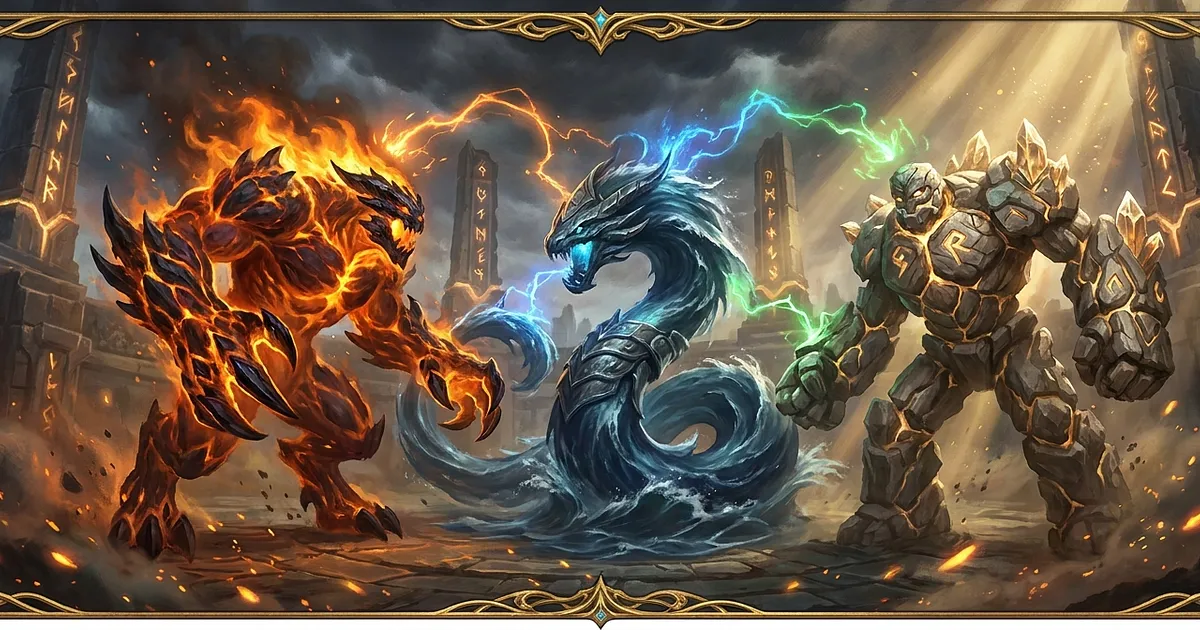
The rebrand came on April 27, 2019, when Steem Monsters officially became Splinterlands, per the same official timeline. The name comes from the "splinters," the game's six warring elemental factions (Fire, Water, Earth, Life, Death, and the Dragon splinter that sits apart from the rest). It's a small thing, a name change, but it signaled the team thought they were building a world, not a tech demo.
The back half of 2019 is where the plumbing got serious. That same timeline logs card delegation arriving in March 2019, a first equity round of 100,000 dollars in April, and an Ethereum bridge that October. The game was reaching past its home chain and starting to look like an actual business rather than a weekend crypto experiment.
DEC and the first real in-game economy
Then came the money layer. Dark Energy Crystals, the game's first proper in-game currency, launched on May 19, 2019, again from Splinterlands' 2019 timeline. DEC is what you earn from battles and quests, and it's what you spend on packs, card rentals, or burning cards back into value.
This is the piece that turned Splinterlands into a genuine play to earn card game rather than a game with tokens bolted on the side. The loop closed. Win battles, earn DEC, spend DEC on things that help you win more battles, and every step of that loop touched an asset with a real, tradeable value outside the game. Plenty of crypto games promised an economy in a whitepaper. Splinterlands shipped one people actually used.
The Hive exodus: when "you own your cards" got stress-tested
Here's the beat that separates a marketing slogan from a proven fact.
In early 2020, Steem got acquired by Justin Sun's Tron, and the new owners moved to push a hard fork that, by Splinterlands' own account, would have seized roughly 5 million dollars in Steem tokens straight out of user wallets. The community forked the chain in response, creating Hive on March 20, 2020. Splinterlands, by then the single most active app on Steem, picked up its entire card economy and moved it over to Hive on June 1, 2020, according to the team's own migration announcement.
Think about what that actually required. A game moved blockchains, wholesale, and nobody lost their collection. That's only possible because the cards were real on-chain assets and not database rows the studio controlled. The "you truly own your cards" pitch got dragged out into a platform-level crisis within two years of launch, and it held. Most crypto promises never survive contact with an actual emergency. This one did.
It also cemented the Hive connection that still defines this branch of the genre. Splinterlands became the flagship Hive blockchain game, and Hive's native delegation feature quietly set up the next trick.
SPS and the 2021 boom
2021 is when Splinterlands stopped being a niche and briefly became a headline.
The governance token, SPS (Splintershards), launched around July 26, 2021. The distribution was the interesting part. 400 million tokens, 13.33 percent of total supply, got set aside for a daily airdrop stretched across a full year, roughly 1.1 million SPS a day, handed out by "Collection Power" rather than a single snapshot (per Splinterlands' own governance-token announcement). Collection Power is basically the burn value of the cards you hold, so the bigger your collection, the bigger your slice of the daily drop. A year-long faucet aimed straight at the people already invested in the game.
It worked, spectacularly, for a while. By some DappRadar-based accounts, Splinterlands' daily active users climbed from around 10,000 in July 2021 to something like 350,000 by the end of the year, at points reportedly the single most active dApp in all of crypto by on-chain activity, ahead of even PancakeSwap. Treat those numbers as reported rather than gospel, since DappRadar's own pages from the era are a pain to pull cleanly these days, but the growth curve shows up consistently across the accounts that cite them.
Alongside SPS, the rental market went live. Splinterlands built an on-site card rental system on top of Hive's native delegation, letting one player lend cards to another for a daily rate without ever transferring ownership, documented in Splinterlands' own docs. A newcomer with no capital could rent a competitive deck for a few days. A whale with a huge collection could earn passive rent off cards they weren't using. A whole scholarship-style lending economy grew out of a single mechanic, and that mechanic only existed because the cards were genuinely owned.
What Splinterlands actually proved
So here's DegenLoot's read, and we'll flag it as our own synthesis rather than pretend some analyst handed it down on a tablet. No single essay draws a clean line from Splinterlands to everything that followed. But look at what it demonstrably shipped first as a working package:
True on-chain ownership that survived a chain migration. Not a slogan. A tested one.
Browser-only, auto-resolving play with no download and no console, which kept the barrier to entry low.
A dual-token economy (DEC for utility, SPS for governance) that real players actually earned and spent.
A rental market that turned ownership into a lending economy nobody had to build by hand.
That combination is the blueprint. Any browser crypto TCG you can name today is playing with some subset of those four pieces, and Splinterlands is the one that proved they hang together in a live game rather than a pitch deck. If you want the "is it still worth playing right now" version of the story, that's a separate question, and we dig into whether Splinterlands still earns its keep in 2026 elsewhere. For the wider field, our roundup of the best browser crypto games you can actually play puts it in context.
Where the genre went next
Now for the honest caveat, because getting this wrong is exactly the kind of thing that torches a blog's credibility.
Splinterlands was not strictly the first blockchain card game. Gods Unchained ran its token presale back in July 2018, only about two months after Steem Monsters launched, so the two are near-contemporaries, not a leader and a follower (Gods Unchained's timeline via Decrypt). Anyone telling you Splinterlands "invented" crypto card games is overselling it. What Splinterlands got to first, and fastest, was the specific browser-plus-economy-plus-rentals combo, not the category itself. If you want the direct matchup, we break down Splinterlands versus Gods Unchained head to head.
After that, the field filled in. Skyweaver reached its public launch in February 2022 (CoinDesk covered it), leaning hard into low-friction, no-download browser play. Parallel later showed up with a sci-fi take and much bigger production values. And the clearest sign that Splinterlands had become a template? By the early 2020s, "Splinterlands clone" was literally a service category blockchain dev shops market against. When your game becomes a noun that agencies sell copies of, you've stopped being a product and become a genre.
Not every follower kept the faith, mind you. The broader play-to-earn boom curdled hard, and the Axie Infinity story is the cautionary tale that hangs over all of it, which we tracked in our Axie Infinity crash timeline. The blueprint proved you could build an owned-asset browser card economy. It never promised the economics would stay pretty.
The blueprint's next chapter
Which brings us to the part of the story that's still being written.
If Splinterlands proved the model, browser play, on-chain cards, and Hive as the home chain, then the interesting question is what a game built later does with what it learned. Stellarch (stellarch.io) is one answer worth watching. It's a browser trading card game on Hive, the same chain family Splinterlands pioneered, and it takes the blueprint in a direction Splinterlands didn't: provably-fair, seed-verifiable determinism. Combat resolves through a seeded-RNG engine, so any match replays byte-for-byte from its seed, and you can check the result yourself instead of trusting the operator. If the whole idea of "check the math yourself" is new to you, here's what provably fair actually means.
The other honest edge is the on-ramp. A brand-new Stellarch account can draft a full legal team of Fighters and play a match with no card purchase and no crypto wallet required, since the draft pool starts from a virtual catalog floor rather than forcing you to buy in first. Splinterlands, credit where it's due, still wins comfortably on player base and market depth. It's the bigger, more established game, full stop. Stellarch's pitch is a different one: verifiable fairness and a genuinely free start.
One thing we won't do is oversell it. Stellarch is in closed alpha with a waitlist right now, not a full public launch. Provably-fair play is live; the crypto deposit, withdrawal, and ranked-earning rails are not, so this is a "come check out the fairness model" invite, not a "come earn crypto" one. If that combination sounds like your kind of thing, join the waitlist for early access and see what a post-Splinterlands blueprint looks like from the inside.
That's the arc. From a card game nobody noticed in 2018 to a template a whole genre still borrows from, one checkable date at a time. Not bad for a project that used a blockchain as its patch notes.
Every date and figure here is sourced inline from Splinterlands' own timestamped history plus independent coverage. DegenLoot holds no Splinterlands or Stellarch assets and makes no first-hand playtesting claims. Last updated August 2026.
Frequently Asked Questions
When did Splinterlands launch and who founded it?
It launched as Steem Monsters on May 26, 2018, on the Steem blockchain, co-founded by Jesse "Aggroed" Reich and Matthew "Yabapmatt" Rosen, per Splinterlands' own company timeline. It rebranded to Splinterlands on April 27, 2019. So the game is older than most people assume, predating the 2021 play-to-earn boom by roughly three years.
Why did Splinterlands move to the Hive blockchain?
In 2020, Steem was acquired by Tron, and the new owners pushed a hard fork that, by Splinterlands' own account, would have seized around 5 million dollars from user wallets. The community forked Hive in response, and Splinterlands migrated its whole card economy over on June 1, 2020. Nobody lost their collection, because the cards were real on-chain assets.
What makes Splinterlands a browser crypto TCG rather than a normal card game?
Three things at once. It plays entirely in a browser with no download, the cards are player-owned on-chain assets you can freely trade or burn, and it runs a real token economy (DEC and later SPS) that players actually earn and spend. That specific package, proven in a live game, is what later browser crypto card games copied.
Was Splinterlands the first blockchain card game?
Not strictly. Gods Unchained ran its token presale in July 2018, only about two months after Steem Monsters launched, so they're near-contemporaries. What Splinterlands got to first was the working combination of browser-only play, on-chain ownership, a dual-token economy, and a rental market, not blockchain cards as a category.
How does Stellarch compare to Splinterlands?
Splinterlands wins on player base and market depth, full stop, as the bigger and more established game. Stellarch is a newer Hive card game with two honest edges: provably-fair seeded determinism you can verify from a match seed, and a free start with no card purchase or wallet needed. It's in closed alpha with a waitlist, so treat it as early access, not a finished launch.
Sources
- Splinterlands' own company timeline docs.splinterlands.com
- Coin Bureau later put it coinbureau.com
- per the same official timeline docs.splinterlands.com
- according to the team's own migration announcement medium.com
- per Splinterlands' own governance-token announcement hive.blog
- documented in Splinterlands' own docs docs.splinterlands.com
- Gods Unchained's timeline via Decrypt decrypt.co
- CoinDesk covered it coindesk.com
- a service category blockchain dev shops market against medium.com
- join the waitlist for early access stellarch.io