Cross the Ages Review: Is This AAA Crypto TCG Worth Your Time in 2026?
 13 min read
gm. If you searched "cross the ages" and landed on a review written in 2023, you got a snapshot of a game that no longer exists in the shape it did back then. This Cross the Ages review is the 2026 version: the card game got rebranded, the token got vaporized, and the studio quietly shipped a whole second game most people never heard about. So the real question isn't whether it's flashy. It's whether any of that is worth your evening.
Here's the short version before we get into the receipts, because you deserve the verdict up front and then all the evidence right after it.
What Is Cross the Ages? A Quick Primer on the Game
Cross the Ages is a blockchain trading card game where you build a deck and fight on a small tactical board. That's the elevator pitch. The longer story is more interesting, and it's the part every stale review misses.
This is not some anonymous Discord project. Cross the Ages raised a $12 million seed round in March 2022 backed by Ubisoft, Animoca Brands, and Polygon, with Sandbox co-founder Sebastien Borget also in the round. Ubisoft putting money into a crypto card game is rare, and honestly it's the single most credible thing on the whole résumé. The CEO, Sami Chlagou, also runs a traditional games publisher, so there's actual industry pedigree here rather than a whitepaper and a dream.
Now the confusing part. "Cross the Ages" in 2026 is really three things wearing one name, and knowing which one someone means matters.
The original TCG launched on Unity back in March 2023. That's the version Decrypt reviewed.
Then there's Cross The Ages: BLAST, the overhauled relaunch of that card game, with a new HP-based win condition instead of the old points cap. It ran a closed playtest in spring 2025 and moved to public Early Access in March 2026.
And completely separate from either: Cross The Ages: Arise, a free Unreal Engine 5 action-RPG in the same fictional universe, which entered alpha on the Epic Games Store in November 2025 and has a Steam page too.
If you take one thing from this section, take that. When someone says "have you tried Cross the Ages," you genuinely have to ask which one they mean. Arise is not a card game and doesn't replace the TCG. Same universe, different genre. The card game you'll actually be reviewing when you download the app today is BLAST.
How the Cross the Ages Game Actually Plays
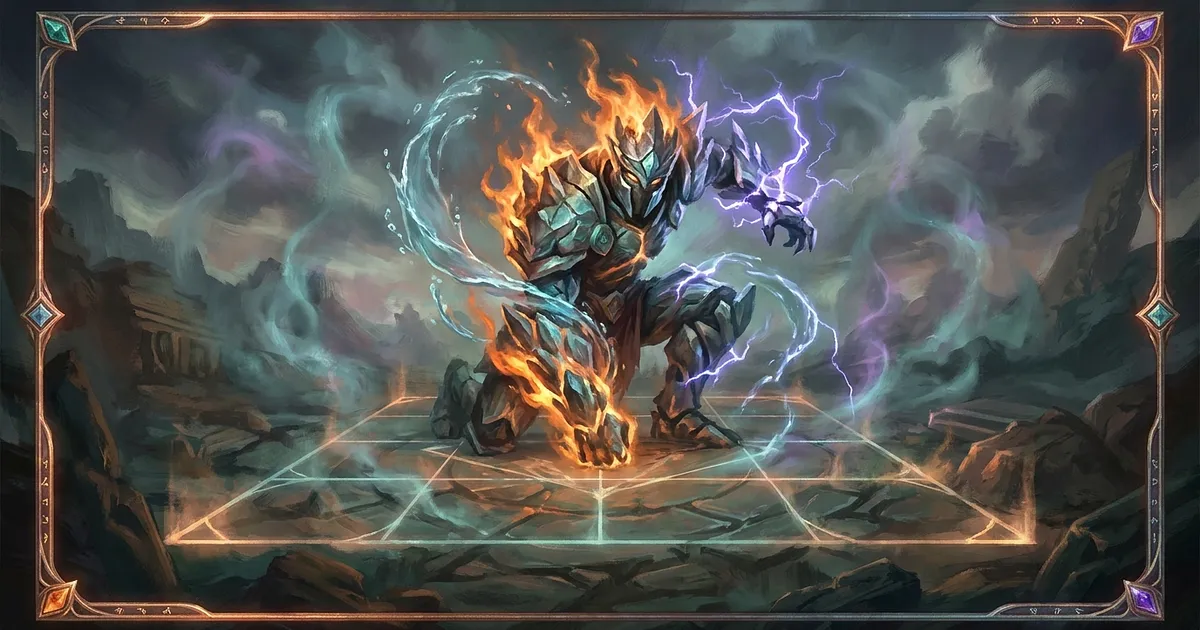
The core loop is a 4x4 tactical board, not the row-of-creatures layout most crypto TCGs copy from Hearthstone. You're placing cards onto a grid and fighting for board control, and there's an elemental type system (the community calls it the Heptagram) layered on top, a rock-paper-scissors web of strengths and weaknesses that decides a lot of your matchups before combat math even kicks in.
Both third-party reviews agree it's mechanically fresher than the average spell-and-creature clone. They also agree on where it hurts. Decrypt's 2023 review called it "a hard game to pick up and equally as difficult to master" and took a shot at the lazy desktop port, while games.gg's more recent review scored it 7.5/10 and praised matches that "wrap up in under 12 minutes."
So the pattern across every honest write-up is the same: smart board, steep on-ramp, weak tutorial. Whether BLAST actually fixed the onboarding is the open question, and I'll be honest, I couldn't find a credible 2026 write-up that specifically re-tested the new tutorial flow, so I'm not going to pretend I know. What I can tell you is that fast matches are a real plus. Twelve minutes to a result respects your time in a genre that often doesn't.
The CTA Token: A 99.9% Cautionary Tale
This is where a crypto-native review has to earn its keep, because nobody on page one of Google will say the quiet part out loud.
The CTA token launched around May 2024 and, per CoinGecko, hit an all-time high of $0.4626 on May 17 that year. As of August 20, 2026, it trades around $0.0003. That's a decline of roughly 99.9% from the peak. Not a typo. If you had put a hundred bucks in near the top, you'd be looking at pocket change now.
Let me be careful about what that does and doesn't mean, because this is exactly the kind of number that gets twisted. A 99.9% drawdown is not, by itself, evidence of a rug pull. I went looking for allegations of insider dumping or an exit scam specific to Cross the Ages and came up empty, and none of the usual rug-pull red flags show up in the public record either. The studio kept shipping (BLAST hit Early Access, Arise hit alpha) well after the token cratered, which is not what a team that grabbed the money and ran usually does. So calling it a rug would be a claim I can't back, and DegenLoot doesn't make claims it can't back.
What it is: a textbook lesson that "funded and real" and "the token holds value" are two completely different questions. One more accuracy note for anyone doing their own homework. Per the official whitepaper, CTA has a fixed max supply of 500 million tokens. Some secondary write-ups float a "1 billion supply" figure. That's wrong, and it matters, because a wrong supply number throws off every market-cap and dilution calc you'd run. Use 500 million.
Bottom line on the token: play the card game if the card game is fun. Do not touch the token expecting it to do anything but sit there. There is no earnings story here worth chasing in 2026.
Does It Actually Run? The Reliability Problem
Here's the gap no editorial review on the SERP fills, and the one you'll actually feel if you download it tonight.
The reliability complaints are sitting right there on the App Store listing. One reviewer wrote the app "constantly crashes," another flagged distorted audio, and one blunt line summed the mood up: it "feels like a closed beta app, not a public launch app." Google Play tells the same story, with reviewers reporting freezes bad enough to force-close and rejoin mid-match.
Two things keep this fair. First, that App Store rating is 4.2 out of 5, which isn't a disaster on its face. Second, and this is the part people skip, it's built on only about 15 ratings. That's a tiny sample. A handful of angry crash reports move a number like that a lot, so read the star score as "barely any data," not "verdict rendered." Meanwhile Metacritic shows zero critic reviews and zero user reviews, which tells you this is still a niche crypto-native title the mainstream games press hasn't bothered with.
My read? The game underneath is more interesting than the wrapper it ships in right now. If you can tolerate a live-service client that's still visibly baking, fine. If you want something that just opens and works every time, this isn't that, at least not yet.
Cross the Ages vs Gods Unchained and Splinterlands
You're probably weighing this against the two crypto TCGs that already own the category, so let's actually compare instead of hand-waving.
Gods Unchained wins on polish and reach. It's got the production values, the marketing budget, and a bigger name, and it's genuinely free to start in a browser. The economics differ in a way that matters for a new player: as one Web3 TCG comparison breaks it down, Gods Unchained sells smaller 5-card packs at varying rarities while Cross the Ages sells larger 20-to-30-card packs. Minimal-spend efficiency leans Gods Unchained; if you like opening bigger batches and want more raw variety per purchase, Cross the Ages has an argument. For the full picture on where Gods Unchained holds up in 2026, see our full Gods Unchained review.
Splinterlands wins on longevity and player base. It's the most-established browser card-battler in the space, it's been running for years, and there's a real economy and a real ladder to climb. Cross the Ages can't touch it on scale. If you want the deeper dive on whether that scale still translates to a good player experience, our honest Splinterlands review covers it.
So where does Cross the Ages honestly land against these two? Its edge is the board. The 4x4 tactical grid plus the elemental Heptagram is a genuinely different game feel than either competitor's linear-lane combat. If mechanical originality is what you're shopping for, that's the pitch. If you're shopping for the biggest live population or the safest track record, it isn't the one. If you're trying to pick between those two instead, our Splinterlands vs Gods Unchained head-to-head breaks that matchup down directly.
Cross the Ages vs Stellarch
Since we're talking honest alternatives, one more comparison belongs here, and I'll hold it to the same standard as the last section.
First the concessions, because Stellarch does not win everything. Cross the Ages is a bigger, further-along product. It has public Early Access, real iOS and Android apps you can install right now, that Ubisoft-backed funding pedigree, and a transmedia IP with books and a whole spin-off RPG behind it. Stellarch has none of that reach. It's a smaller game currently in closed alpha with a waitlist, so it isn't the game everyone's playing, and I'm not going to pretend otherwise.
Now the axes where it answers Cross the Ages' actual weaknesses.
The token problem first. Cross the Ages ties a chunk of its story to a token that fell 99.9%, and the on-chain economy is the kind of opaque, financialized layer that burned a lot of players in this cycle. Stellarch's whole pitch runs the other direction: it's provably fair. Combat resolves through a seeded-RNG engine, so every match replays byte-identically from its seed. You can re-run the seed and check the result yourself instead of trusting the operator. See what provably fair actually means if that term is new to you. That's a fairness story you can verify, not a token you're asked to speculate on. To be clear, Stellarch isn't dangling an earnings pitch either, crypto deposit and withdrawal rails aren't live and ranked-earning isn't switched on, so the honest draw is verifiable fairness and free play, not a way to cash out.
Then the on-ramp. Getting properly started in a crypto TCG usually means buying cards and wiring up a wallet, and Cross the Ages' reliance on NFT ownership is part of that friction. Stellarch is free to start with no purchase: a brand-new account draws from a virtual "ghost catalog" floor, so you can draft a full legal team of Fighters and battle without minting or buying a single card. And you don't need a wallet to try it. You can sign up with just email or Google, and a crypto wallet is optional, not a gate. It runs in the browser too, so there's nothing to install and no crash-prone client to babysit.
So the honest verdict: if you want the more finished product with a bigger catalog behind it and you don't mind the rough client, Cross the Ages is the more complete package today. If what soured you on Cross the Ages was the dead token and the wallet-and-purchase friction, Stellarch answers both directly, as long as you're okay joining a waitlist for a game that's still in alpha. You can get early access to Stellarch here if that trade sounds right.
So, Is Cross the Ages Worth It in 2026? Our Review Verdict
Depends what you're here for, and that's really what this Cross the Ages review comes down to. As a card game, it's genuinely worth a look: the board is clever, matches are quick, and the studio is real and still shipping. As an investment, it's a lesson, not an opportunity, that token isn't coming back and you shouldn't want it to. And as a polished product you can rely on tonight, it's not there yet, going by the crash reports players keep leaving.
That's the checkable version. Download BLAST if a fresh tactical TCG sounds fun and you can stomach a beta-grade client. Skip the token entirely. And if the fairness-and-friction stuff is what actually matters to you, put your email on the Stellarch waitlist and try a provably-fair, no-wallet-needed match when your early access lands.
Frequently Asked Questions
Is Cross the Ages still worth playing in 2026?
As a card game, yes, if you want something different. The 4x4 tactical board and elemental type system are fresher than most crypto TCGs, matches finish in around 12 minutes, and the studio is still actively shipping updates. The catch is a rough, crash-prone client and a token you should ignore completely. Play it for the game, not the economy.
What is the CTA token and is it worth anything?
CTA is Cross the Ages' crypto token. It hit an all-time high of $0.4626 in May 2024 and now trades around $0.0003 per CoinGecko, a fall of roughly 99.9%. There's no evidence of a scam, the team kept building after the crash, but the token has performed terribly. Treat it as dead money and enjoy the card game on its own merits.
What's the difference between Cross the Ages, BLAST, and Arise?
They share one universe but they're different products. The original was the 2023 Unity card game. Cross The Ages: BLAST is that card game relaunched with a new HP-based combat system, in public Early Access as of March 2026. Cross The Ages: Arise is a separate free action-RPG on Unreal Engine 5 that hit Epic Games Store alpha in November 2025. If you want the TCG, you want BLAST.
Is Cross the Ages pay-to-win?
There are pay-to-win elements, since owning stronger cards helps, but reviewers note a total deck-power cap that limits how far money alone carries you. It's less brutal than some rivals on that front. You can start without heavy spending, though a competitive collection still costs, which is normal for the genre.
Is Cross the Ages a scam or a rug pull?
Nothing in the public record supports that. No insider-dumping or exit-scam allegation specific to Cross the Ages turned up in research, and the studio has kept shipping games (BLAST, Arise) years after the token peaked. The token collapsed hard, which is bad, but a price crash is not proof of fraud. Call it a poor token, not a rug.
Do I need a crypto wallet to play Cross the Ages?
You can install the BLAST app and try the game without diving straight into crypto, but the project is built around NFT card ownership, so getting the full experience leans on wallet and blockchain features. If a totally no-wallet start is what you want, browser TCGs like Stellarch let you sign up with just email or Google and play without one.
Sources
- CoinGecko coingecko.com
- $12 million seed round in March 2022 backed by Ubisoft, Animoca Brands, and Polygon decrypt.co
- Early Access in March 2026 crosstheages.com
- entered alpha on the Epic Games Store in November 2025 chainwire.org
- 2023 review decrypt.co
- games.gg's more recent review games.gg
- official whitepaper whitepaper.crosstheages.com
- App Store listing apps.apple.com
- Web3 TCG comparison medium.com
- Stellarch stellarch.io